


Good engineering is not just about writing functional code—it’s about building scalable, secure, and maintainable systems that enable business growth, enhance user experience, and foster innovation.
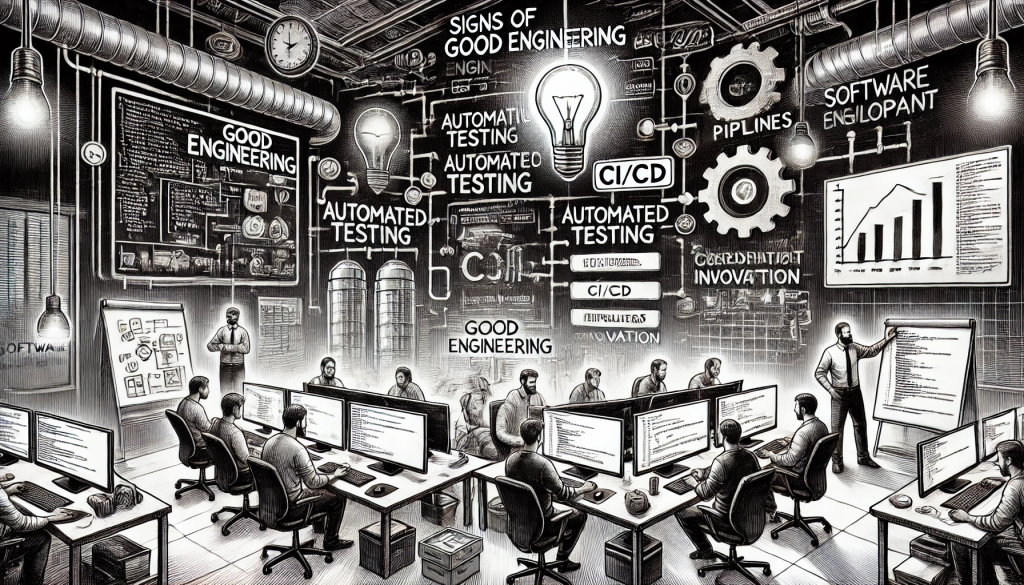
Here are key indicators of strong engineering:
1. Fast & Reliable Product Development
🔹 Symptoms of Good Engineering:
- Features are developed and released quickly & consistently.
- Engineers follow Agile & DevOps best practices, reducing friction in deployments.
- There is a well-defined CI/CD pipeline for automated testing and deployments.
- Minimal bottlenecks in code reviews, testing, and releases.
🔹 Why It Matters:
✅ The company can respond to market demands faster.
✅ Competitive advantage through rapid iteration and innovation.
✅ Engineers can focus on building, not fixing past mistakes.
Example: Amazon deploys updates every 11.7 seconds, allowing continuous improvements with minimal disruption.
2. High Code Quality & Maintainability
🔹 Symptoms of Good Engineering:
- Code is readable, well-structured, and documented.
- Engineers follow coding standards and perform thorough code reviews.
- Codebases have modular and reusable components.
- Minimal technical debt—legacy code is proactively refactored.
🔹 Why It Matters:
✅ Faster onboarding for new engineers.
✅ Easier to debug, modify, and scale without breaking things.
✅ Reduces long-term maintenance costs.
Example: Google enforces strict code reviews and best practices across all teams, ensuring high-quality, scalable code.
3. Strong Collaboration Between Engineering, Product & Design
🔹 Symptoms of Good Engineering:
- Engineering, Product, and Design teams work closely together.
- Engineers understand the business goals and user needs.
- Clear and frequent communication between teams.
- Engineers actively contribute to product discussions instead of just executing tasks.
🔹 Why It Matters:
✅ Ensures the product solves real customer problems.
✅ Reduces misalignment, rework, and frustration.
✅ Encourages innovation from engineers, not just execution.
Example: Spotify engineers, designers, and product managers co-create features to ensure seamless user experiences.
4. Scalable & Performant Systems
🔹 Symptoms of Good Engineering:
- Architecture is designed for growth (microservices, event-driven, cloud-native).
- Performance optimizations prevent slow loading times and lag.
- Auto-scaling infrastructure handles spikes in traffic smoothly.
- Load testing and performance monitoring are part of the development process.
🔹 Why It Matters:
✅ Supports millions of users without crashes.
✅ Prevents expensive downtime and performance issues.
✅ Reduces infrastructure costs by optimizing resource usage.
Example: Netflix uses a microservices and cloud-native approach, allowing it to scale globally with minimal latency.
5. Security is a First-Class Citizen
🔹 Symptoms of Good Engineering:
- Security is integrated throughout the development lifecycle (DevSecOps).
- Automated security tests check for vulnerabilities before deployment.
- Encryption, access controls, and secure coding practices are standard.
- Regular penetration testing and compliance audits.
🔹 Why It Matters:
✅ Protects user data and company reputation.
✅ Avoids expensive security breaches and legal penalties.
✅ Ensures compliance with regulations like GDPR, HIPAA, SOC 2.
Example: Apple prioritizes end-to-end encryption, ensuring customer privacy across all devices.
6. Data-Driven Decision Making
🔹 Symptoms of Good Engineering:
- Engineering teams use real-time analytics and observability.
- A/B testing and feature flagging are used before full rollouts.
- Data pipelines collect metrics on performance, errors, and user behavior.
- Engineering decisions are informed by metrics, not assumptions.
🔹 Why It Matters:
✅ Engineers can identify and fix issues proactively.
✅ Helps teams prioritize high-impact improvements.
✅ Reduces guesswork in feature development.
Example: Google continuously analyzes billions of search queries to refine its search algorithms and improve user experience.
7. Low Incident Rate & Quick Recovery
🔹 Symptoms of Good Engineering:
- Rare system failures or downtime.
- Automated monitoring & alerts detect issues before customers do.
- Engineers can quickly rollback or fix bugs with minimal disruption.
- A strong Incident Response Plan (IRP) ensures rapid recovery.
🔹 Why It Matters:
✅ Minimizes impact on customers and business revenue.
✅ Engineers spend less time firefighting, more time innovating.
✅ Strengthens trust in the product.
Example: Google SRE (Site Reliability Engineering) teams ensure 99.999% uptime for services like Gmail and YouTube.
8. Strong Culture of Learning & Continuous Improvement
🔹 Symptoms of Good Engineering:
- Engineers are encouraged to experiment, learn, and improve.
- The company invests in mentorship, training, and knowledge-sharing.
- Engineering teams conduct retrospectives and post-mortems.
- Healthy work-life balance, preventing burnout.
🔹 Why It Matters:
✅ Retains top engineering talent.
✅ Fosters a culture of innovation and continuous learning.
✅ Reduces turnover and knowledge loss.
Example: Facebook hosts internal hackathons to encourage engineers to explore new ideas, many of which turn into real products (e.g., Facebook Timeline).
9. Engineers Have Ownership & Autonomy
🔹 Symptoms of Good Engineering:
- Engineers own their code from development to production.
- Teams are empowered to make technical decisions.
- Clear accountability but without micromanagement.
- Blameless post-mortems focus on fixing, not blaming.
🔹 Why It Matters:
✅ Boosts motivation, creativity, and responsibility.
✅ Engineers feel invested in the product’s success.
✅ Faster problem-solving with less bureaucracy.
Example: At Google, engineers can dedicate 20% of their time to independent projects, leading to innovations like Gmail and Google Maps.
Final Thoughts: Great Engineering Drives Business Success
✅ Fast & reliable releases → Business can respond to customer needs quickly.
✅ Scalable & secure systems → Product grows without technical bottlenecks.
✅ Data-driven & collaborative culture → Teams build the right things efficiently.
✅ Empowered engineers → Better morale, retention, and innovation.
Good engineering isn’t just a technical advantage—it’s a business enabler. Companies that invest in strong engineering practices will outpace competitors, retain top talent, and create world-class products.
Effects of Good Engineering in a Product-Centric Software Company
Good engineering is more than just writing clean code—it drives business success, enhances user experience, and fuels innovation. Here’s how strong engineering practices positively impact a company:
1. Faster Product Development & Innovation
🔹 Effects:
- Features and improvements are delivered quickly and reliably.
- Agile development allows rapid experimentation & iteration.
- CI/CD pipelines enable frequent, low-risk deployments.
✅ Impact:
✔ Faster time-to-market → The company stays ahead of competitors.
✔ Ability to test & pivot quickly based on market trends.
✔ Higher customer satisfaction as users see regular improvements.
Example:
Facebook engineers release daily updates, allowing them to test and refine features rapidly.
2. Higher Product Quality & Fewer Bugs
🔹 Effects:
- Codebases are clean, maintainable, and well-documented.
- Automated testing & quality assurance reduce defects before release.
- Fewer critical incidents & downtime due to proactive monitoring.
✅ Impact:
✔ Reduced customer frustration → Fewer complaints & churn.
✔ Lower maintenance costs → Engineers focus on building, not fixing.
✔ Better company reputation → Users trust a well-functioning product.
Example:
Apple’s strict engineering standards ensure smooth, high-performance products, driving strong brand loyalty.
3. Scalability & Performance for Business Growth
🔹 Effects:
- Systems are built to handle large user growth without breaking.
- Cloud-native, microservices, and distributed architectures support scalability.
- Performance monitoring & optimizations keep applications fast.
✅ Impact:
✔ Handles millions of users without lag or crashes.
✔ Prevents costly system overhauls by designing scalable software early.
✔ Improves conversion rates & user engagement with faster performance.
Example:
Netflix’s cloud-based microservices architecture allows it to serve millions of users seamlessly worldwide.
4. Lower Costs & Increased Efficiency
🔹 Effects:
- Automated processes (testing, deployments, monitoring) save time.
- Optimized cloud & infrastructure lowers operational expenses.
- Reduced technical debt prevents expensive rewrites in the future.
✅ Impact:
✔ Lower engineering costs → More budget for innovation.
✔ Less time fixing issues → Engineers focus on building new features.
✔ Efficient use of resources → Avoids over-provisioning infrastructure.
Example:
Amazon AWS optimizes infrastructure to reduce costs while maintaining performance, passing savings to customers.
5. Stronger Security & Compliance
🔹 Effects:
- Security is integrated from the start (DevSecOps).
- Automated security testing detects vulnerabilities early.
- Regulatory compliance (GDPR, HIPAA, SOC 2) ensures legal adherence.
✅ Impact:
✔ Prevents data breaches & cyberattacks that could destroy trust.
✔ Avoids costly legal fines for non-compliance.
✔ Builds brand credibility → Users trust their data is safe.
Example:
Apple’s end-to-end encryption and privacy focus make it a leader in data security.
6. Happier & More Productive Engineers
🔹 Effects:
- Clear engineering best practices & automation reduce repetitive work.
- Healthy work-life balance prevents burnout.
- Opportunities for learning & innovation keep engineers engaged.
✅ Impact:
✔ Higher retention rates → Keeps top talent in-house.
✔ Faster development cycles → Engineers work efficiently.
✔ Innovative solutions → Engineers contribute to cutting-edge features.
Example:
Google’s 20% time rule allows engineers to innovate, leading to products like Gmail and Google Maps.
7. Better Collaboration Across Teams
🔹 Effects:
- Engineers work closely with Product, Design, & Business teams.
- Well-documented APIs & architectures make collaboration easier.
- Transparent communication & shared goals improve alignment.
✅ Impact:
✔ Less friction between departments → Faster decision-making.
✔ More user-centric features → Engineering aligns with business needs.
✔ Reduced project delays → Fewer misunderstandings & rework.
Example:
Spotify’s “Squad Model” allows cross-functional teams to collaborate effectively on new features.
8. Data-Driven Decision Making & Continuous Improvement
🔹 Effects:
- Engineering integrates analytics & telemetry for real-time insights.
- A/B testing & feature flagging allow controlled rollouts.
- Data pipelines & machine learning enhance personalization.
✅ Impact:
✔ More informed product decisions based on real user behavior.
✔ Faster identification of issues → Prevents revenue loss.
✔ Smarter automation & AI-driven features improve customer experience.
Example:
Google Search constantly evolves based on billions of search queries analyzed daily.
9. Competitive Advantage & Market Leadership
🔹 Effects:
- Engineering innovation creates unique product features.
- The company adapts quickly to industry changes.
- A reputation for reliability & performance attracts customers.
✅ Impact:
✔ More customer loyalty → People prefer products that work flawlessly.
✔ Easier to attract top engineering talent → Strengthens the company.
✔ Sustained business success → Long-term profitability & growth.
Example:
Tesla’s software-driven approach to car updates gives it an edge over traditional automakers.
10. Long-Term Business Growth & Success
🔹 Effects:
- A strong engineering foundation supports sustainable scaling.
- Automation & modern tech stacks ensure longevity.
- A culture of learning & continuous improvement drives innovation.
✅ Impact:
✔ The company grows without being held back by tech limitations.
✔ Revenue & profitability increase as product adoption grows.
✔ Investor confidence strengthens due to a robust technology strategy.
Example:
Amazon’s engineering-first approach to scaling AWS turned it into a trillion-dollar company.
Final Thoughts: Good Engineering Powers Business Success
✅ Faster innovation & releases → The company can respond to customer needs quickly.
✅ High product quality & security → Fewer issues, more trust from users.
✅ Lower costs & improved efficiency → Maximizes profits & sustainability.
✅ Happier engineers & collaboration → Boosts productivity & creativity.
✅ Competitive advantage → Establishes market leadership & long-term success.
Companies like Google, Amazon, Netflix, and Tesla thrive because they invest in strong engineering culture, automation, and continuous improvement. 💡
Good engineering is not just about coding—it’s about building a company’s future.