

If every senior leader wants high-performing teams, then why do so many teams operate like underpowered engines in luxury cars—capable of greatness but somehow stuck in the slow lane?
You can hire the best engineers, the most innovative designers, and the sharpest product minds, yet still end up with a team that struggles to deliver real impact. Why? Because performance isn’t just about who’s in the car; it’s about how the vehicle is designed, how it’s maintained, and—most critically—who’s driving.
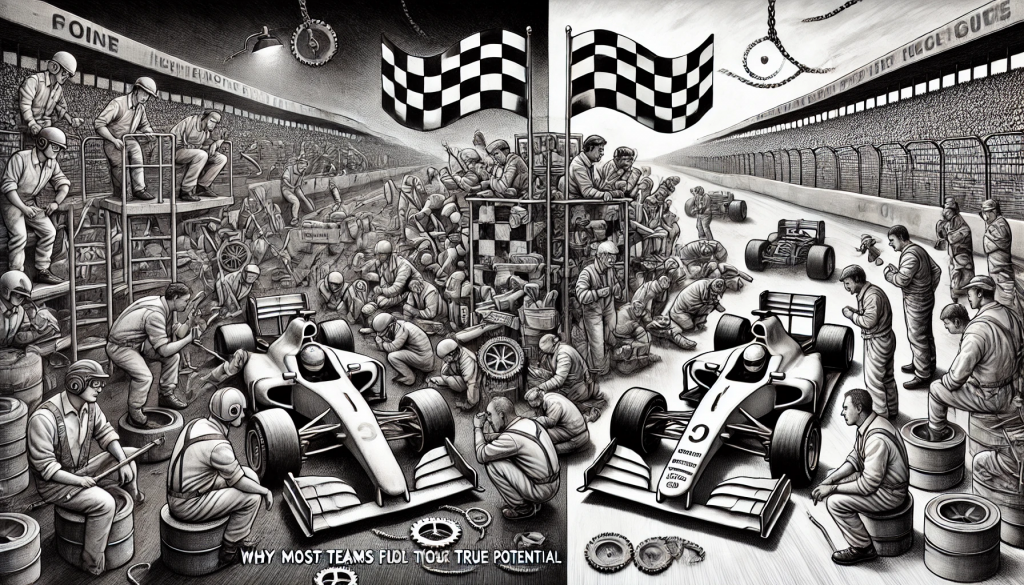
The Illusion of High Performance
Many leaders believe that as long as their teams are busy, they must be performing well. They celebrate output over impact, mistaking high velocity for high value.
- A team that ships 50 features a quarter? 🚀
- A team that works late nights and weekends? 🔥
- A team that follows every Agile ritual perfectly? ✅
Sounds impressive, right? Except that none of this guarantees actual results. What if 45 of those features go unused? What if burnout destroys morale? What if Agile is just a performance for management, rather than a tool for agility?
This is the trap of brittle teams—teams that appear strong on the surface but crack under real pressure.
What Breaks Teams? The Five Performance Killers
Think of a high-performing team like a finely tuned race car. To win the race, it needs power, precision, and adaptability. But many teams are stuck with:
1️⃣ The Wrong Fuel: Output Over Outcomes
Would you measure an F1 car’s success by the number of laps completed or whether it actually wins races? Many organizations focus on the wrong metrics, rewarding activity instead of impact.
Fix: Stop measuring success by how much gets built. Measure how much gets used, how much improves customer experience, and how much drives business success.
2️⃣ A Broken Steering System: Command-and-Control Leadership
Some leaders treat their teams like factory workers rather than expert drivers. Instead of trusting them to navigate complex problems, they impose rigid controls, slowing down decision-making.
Fix: Give teams autonomy within clear guardrails. The best leaders set direction, then get out of the way.
3️⃣ Bad Suspension: No Psychological Safety
A team that’s afraid to fail is like a car with bad suspension—it won’t take risks, won’t innovate, and won’t push boundaries. Instead, it sticks to the safe road, missing opportunities for real breakthroughs.
Fix: Encourage experimentation. Celebrate learning, even from failure.
4️⃣ The Wrong Tires: Overloaded with Process
Agile, SAFe, Scrum—frameworks meant to increase agility often end up doing the opposite when misapplied. Teams spend more time in meetings, status updates, and planning rituals than actually delivering value.
Fix: Optimize for speed and efficiency, not process for process’s sake.
5️⃣ A Distracted Driver: No Clear Vision
Even a perfectly engineered car is useless if no one knows where to drive it. Many teams suffer from unclear priorities, shifting goals, and endless distractions.
Fix: Align teams with a strong product vision and a clear definition of success.
Who Benefits from Keeping Teams Stuck?
It’s easy to blame teams for underperformance, but often, the real culprits are the systems they operate within.
- Executives benefit from the illusion of high performance—lots of output, lots of movement, little accountability.
- Middle management benefits from excessive process, keeping themselves relevant by creating more rules and more status updates.
- Vendors benefit from endless training, tooling, and certifications that don’t actually drive results.
The people who don’t benefit? The ones doing the work. The ones who care about real impact. The customers who expect better products.
The High-Performance Playbook: From Brittle to Elite Teams
So, what separates elite teams from struggling ones? It’s not talent alone—it’s how they’re set up for success.
- Elite teams measure success by impact, not effort.
- They have the autonomy to make decisions.
- They work in environments that encourage innovation, not fear.
- They follow processes that support them, not slow them down.
- They have leaders who trust them to drive.
Final Thought: The Pit Stop vs. The Race
The best race car teams don’t just focus on speed; they focus on strategy, precision, and adaptability. They understand that a well-timed pit stop can be the difference between winning and losing.
The same is true for high-performing teams. It’s not about doing more—it’s about doing better.
So, if your team isn’t performing at its best, don’t ask who is slowing you down. Ask what’s wrong with the vehicle, the track, and the strategy. Because the problem isn’t the driver—it’s how the race is being run. 🚗🏆