


Sailing Beyond the Efficiency Mirage
Have we become so enamored with numbers and speed that we’ve lost sight of what truly makes software development productive? Here’s a provocative truth: measuring software development productivity solely through quantitative efficiency metrics is like judging a ship solely by its speed—ignoring the seaworthiness, cargo, crew’s condition, and final destination.
Too often, software companies eagerly embrace numbers that promise clarity. Metrics like velocity, cycle time, and throughput dazzle management dashboards and fuel confident decisions. But beware—these numbers, seductive as they are, often tell an incomplete story.
Efficiency vs. Effectiveness: A Vital Distinction
Efficiency—doing things right—is the measure of how quickly and economically code can be produced. Effectiveness, on the other hand, is about doing the right things—producing software that genuinely solves user problems. Then there’s the right pace, ensuring that speed doesn’t sacrifice long-term sustainability or compromise quality.
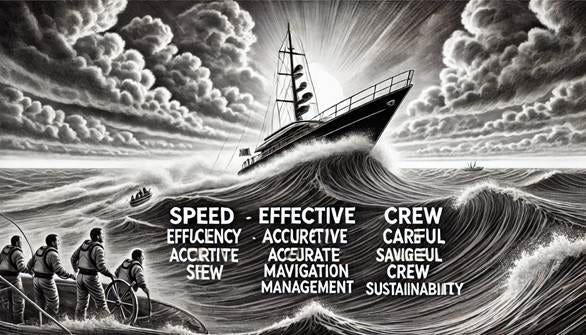
Consider a yacht racing through stormy waters. Efficiency is the yacht’s hull cutting through the waves swiftly. Effectiveness is ensuring the yacht’s heading takes it toward the correct harbor—not into hidden reefs. Sustainability ensures the crew doesn’t burn out halfway to their destination. All three—efficiency, effectiveness, and sustainable pace—must coexist to ensure lasting success.
Real-World Lessons from the Efficiency Trap
I’ve seen firsthand companies seduced by the allure of efficiency metrics. A global tech firm proudly touted its rapid deployment frequency, celebrating near-daily releases. However, customers suffered through countless bugs, constant interruptions, and disappointing experiences. Here, efficiency metrics alone created the illusion of progress—yet fundamentally failed the end-users. In contrast, organizations embracing comprehensive metrics—defect density, customer satisfaction scores, and escaped defects alongside velocity—ensure speed never comes at the cost of user trust.
Conversely, I’ve witnessed slower-moving organizations paralyzed by overly cautious, conservative processes. Obsessed with defect-free releases, they seldom measured actual user value or innovation pace. They forgot that moving at a snail’s pace with perfect quality is pointless if the market opportunity has sailed away.
Who Really Benefits from Single-Dimensional Metrics?
Here’s a critical yet rarely asked question: who truly benefits from an obsessive focus on quantitative efficiency alone? Often, it’s management seeking easy reassurance. Numbers can make management feel secure, offering a comforting illusion of control. But true product value—measured in satisfied customers, impactful solutions, and sustainable progress—often suffers as teams chase superficial milestones.
The most successful companies I’ve guided blend multiple quantitative and qualitative metrics, recognizing that a holistic approach yields genuine productivity. Metrics such as defect density, mean time to recovery (MTTR), and customer satisfaction are used in concert with traditional velocity or throughput measurements, creating a multidimensional view that truly reflects organizational health.
Choosing the Right Metrics: A Balanced Voyage
A balanced measurement framework, such as Pivot Point, emphasizes strategic oversight, user-centered experiences, engineering efficiency, reliable quality, innovation, and scalable architecture. When each dimension is considered, productivity isn’t merely about speed; it’s about meaningful outcomes, market relevance, and long-term sustainability.
Think of it this way: measuring software productivity quantitatively without considering quality and effectiveness is like racing a finely-tuned sports car directly toward a cliff’s edge. Sure, you’re fast, efficient, and exhilaratingly productive—until suddenly you’re not.
Final Thoughts: Beyond the Numbers
So, let me leave you with this: Productivity in software development isn’t simply a numbers game. It’s a delicate balance between efficiency, effectiveness, and sustainable pacing. As you chart your organization’s course, remember that real productivity means arriving at your intended harbor safely, swiftly, and ready for the next voyage—not just setting speed records across empty oceans.