


Let’s be blunt: claiming AI-readiness because you’ve got a cloud subscription and a few proof-of-concepts is like calling yourself fit because you bought running shoes. It’s not just naïve—it’s dangerous.
We’re in an era where AI is being pitched as the messiah for every operational inefficiency, customer frustration, or data problem. But real AI-readiness isn’t about enthusiasm. It’s about infrastructure, intent, and integrity. And most tech stacks—and leadership mindsets—are simply not there yet.
If Your Data Architecture Is a Museum, AI Can’t Live in It
Let’s start with the dirty secret: most enterprise data isn’t ready for AI. It’s trapped in silos, misaligned across domains, and “governed” in a way that makes access a bureaucratic marathon. You’re not working with a data foundation—you’re excavating a digital fossil bed.
Take automotive. One major OEM tried to implement predictive maintenance across its European fleet. On paper, the AI model was flawless—real-time IoT streams, anomaly detection, integration with service centers. In practice? A six-month delay because telemetry data formats weren’t standardized across vehicle models, and the ERP system couldn’t consume the insights without manual intervention. The model was fine. The plumbing failed.
Data readiness isn’t sexy, but it’s everything. It’s the difference between a racetrack and a parking lot. And without clean, connected, and context-rich data, AI becomes theater.
AI Without Engineering Maturity Is a Concept Car With No Engine
Too many AI projects are hyped like concept cars at trade shows—sleek, promising, and utterly disconnected from production reality.
In the e-commerce world, one unicorn retailer rolled out a “hyper-personalized” recommendation engine powered by generative AI. Brilliant idea—on paper. In reality, they couldn’t get new models deployed to production because their CI/CD pipeline didn’t support ML artifacts. Result? Marketing got a flashy demo. Customers got nothing new. Revenue? Flat.
If you can’t engineer, you can’t AI. This is where executives often get it wrong—they think of AI as a magic overlay, when it’s actually a deep integration challenge. Without observability, automation, and DevOps discipline, you’re playing with fire on a fuel-soaked track.
ERP + AI = The Illusion of Control
Let’s talk about ERP—where dreams of intelligent automation often go to die.
An enterprise resource planning vendor recently launched an AI-powered “autonomous procurement assistant.” Sounds futuristic. The catch? It worked beautifully in sandbox demos but struggled in client environments where purchase categories weren’t normalized, supplier master data was outdated, and workflows were hard-coded in 2008 logic.
The result? False positives, missed cost-saving opportunities, and procurement teams overriding AI suggestions 80% of the time. Why? Because the systems weren’t built to learn. They were built to control.
If your ERP is a monolith, AI won’t make it smarter. It’ll just expose how dumb your processes already are.
So Who’s Actually Winning With AI?
Here’s the twist: the people benefiting most from AI today aren’t your users or your customers. They’re your vendors. The platform providers, the consultancies, the pitch-deck wizards who’ve learned to rebrand analytics dashboards as “AI-enabled decision intelligence.”
But what about the end-user? The operations manager? The supply chain planner? The warehouse picker? If their experience hasn’t changed—if AI isn’t helping them do their jobs faster, better, or smarter—then it’s a failure. A technically impressive one, perhaps. But still a failure.
This is why Experience is non-negotiable in the Pivot Point framework. Real AI-readiness asks: Who benefits—and how quickly?
AI-Readiness Is Holistic or It’s Hype
Executives need to stop viewing AI as a shiny object and start seeing it as a stress test—for their architecture, engineering, experience design, and above all, management maturity.
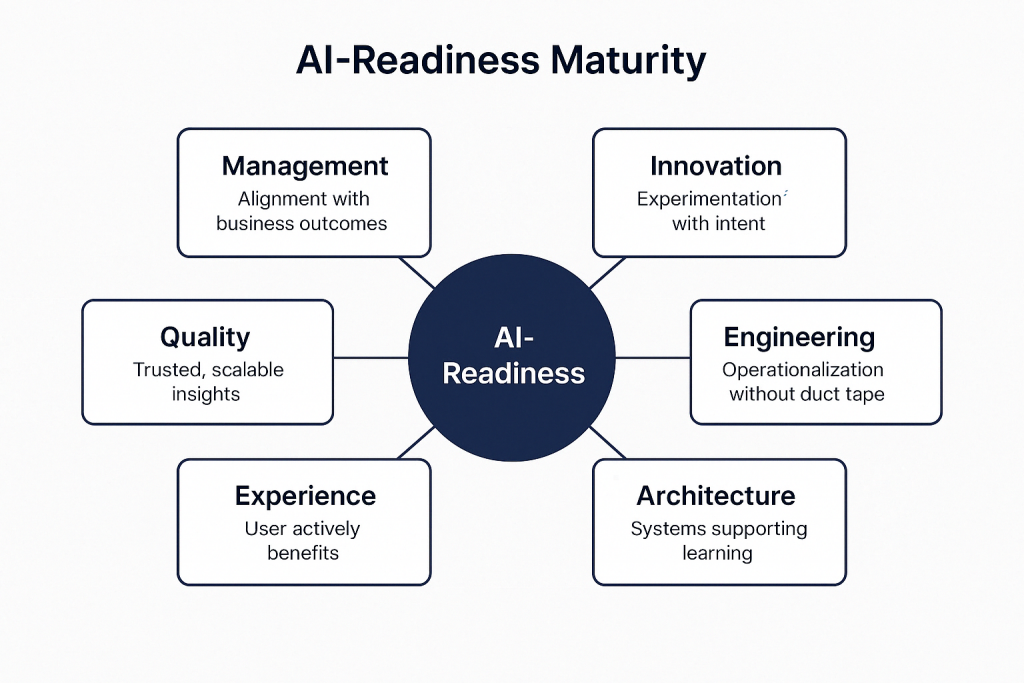
The Pivot Point view is crystal clear here. AI-readiness spans:
| Management | Are we aligning AI with real business outcomes or chasing novelty? |
| Innovation | Are we experimenting with intent or just mimicking competitors? |
| Engineering | Can we operationalize AI without duct tape and prayer? |
| Architecture | Can our systems support learning, not just processing? |
| Experience | Is the user better off, or just confused? |
| Quality | Can we trust the insights, scale the results, and sleep at night? |
Ignore any one of these, and you’ll build a fast car that crashes at the first corner.
Final Gearshift: AI Isn’t an Upgrade—It’s a Driver Change
Here’s your metaphor: AI isn’t a turbocharger for your current systems—it’s a completely different driver. One that sees the track from above, reacts in milliseconds, and doesn’t care how your old tools worked.
If your systems, processes, and teams aren’t ready to hand over the wheel—even partially—then AI will stall. Or worse, it’ll take you somewhere you didn’t intend to go, fast.
So the real question for tech and product leaders isn’t “Are we using AI?” It’s:
“Are we built for it to work?”