


The belief: AI will kill software engineering
It starts as a whisper in forums, then grows louder in boardrooms: “Why do we still need engineers if AI can code?” Auto-complete tools finish your functions. GitHub Copilot spits out boilerplate faster than you can say “for-loop.” LLMs like GPT-4 can refactor code, write unit tests, and even scaffold apps from scratch.
The logic seems inevitable: if the machine can do the typing, what do we need the typists for?
But here’s the uncomfortable truth: what’s dying isn’t software engineering. It’s the illusion of it.
What’s really dying
AI is squeezing the oxygen out of the low-skill, high-volume coding economy. The copy-paste merchants. The ticket-takers. The infinite JIRA wheel of mediocrity. The ones who learned to survive by Googling stack traces, not by understanding the systems underneath.
And maybe that’s a good thing.
Because real software engineering isn’t about producing code. It’s about producing consequences — outcomes through code, not lines of it. It’s about understanding:
- Why this system exists at all
- What trade-offs are acceptable in design
- Where the risk lives in the stack
- How systems degrade, recover, evolve
Typing is incidental. Thinking is essential.
So what AI is really killing is the illusion that software engineering is glorified typing. It’s stripping the varnish off a profession that desperately needed a reckoning.
What’s being born (again)
The new software engineer is closer to a systems architect, product strategist, or even tech philosopher. The job won’t be “write function X.” It’ll be:
- Model a resilient system under volatile demand.
- Choose between speed-to-market and maintainability with eyes wide open.
- Design architecture that aligns with business capability, not legacy baggage.
- Leverage AI tools not to replace thinking, but to amplify it.
AI becomes the engine. Engineers become the drivers. And no serious driver thinks the car drives itself because the pedal moves on command.
The future belongs to those who: – Master abstractions, not just APIs – Think in flows, not files – Collaborate across disciplines, not just repos – Ask the hard why before reaching for the easy how
The lazy coder is endangered. The strategic engineer is rising.
The real danger?
The real danger isn’t that AI will replace engineers. It’s that companies will keep hiring the wrong kind of engineers and expect different results. That they’ll automate the trivial, ignore the structural, and wonder why nothing scales.
AI won’t kill engineering. It will kill the illusion that we’ve been doing it well.
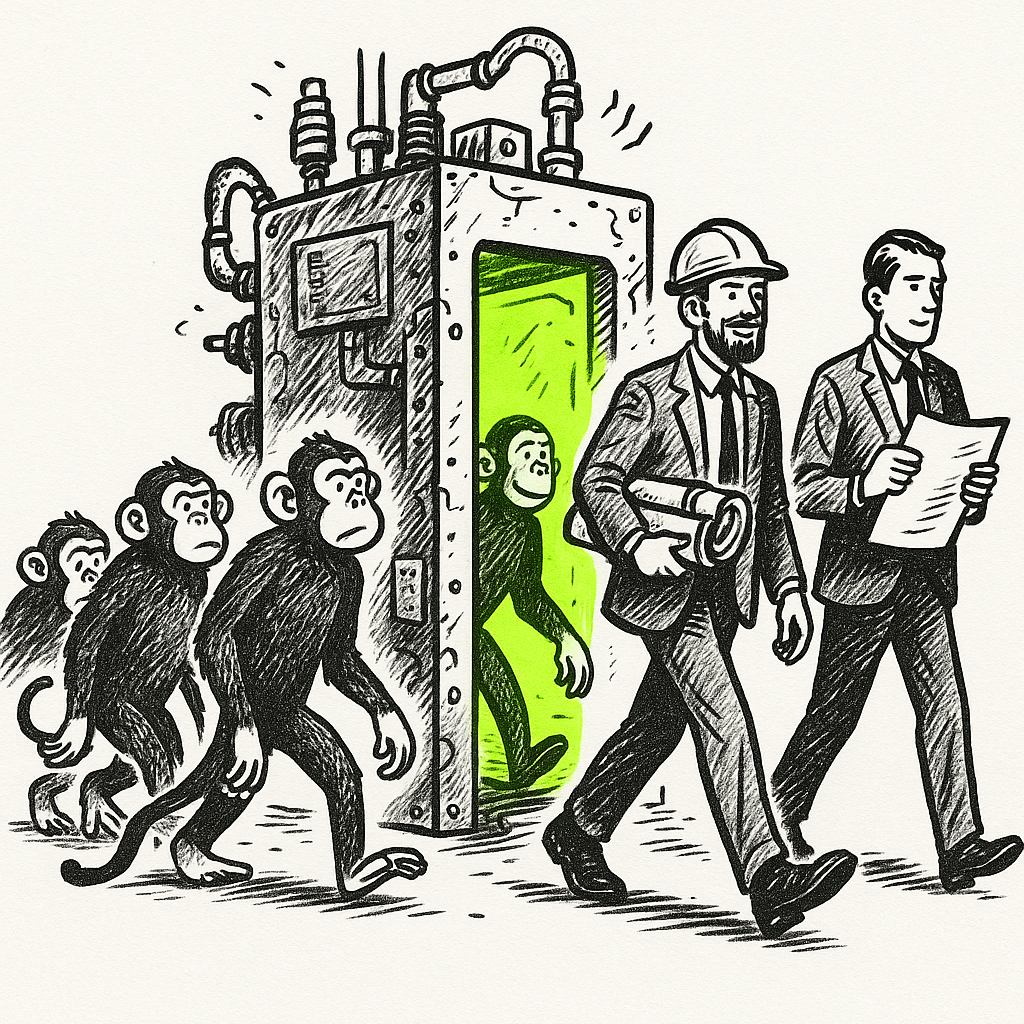
So yes, say goodbye to code monkeys.
And say hello to the return of real engineers — the ones who think, challenge, design, and lead.
Because in the end, AI doesn’t replace the engineer. It demands one.