


Act I: The Dream That Imploded
The cloud was supposed to be your freedom ticket.
No more release-day firefights. No more begging for staging environments.
Just infrastructure as code, CI/CD like clockwork, and developers focused on building.
You pictured it:
Deployments with a click.
Environments in seconds.
Velocity without sacrifice.
And for a while, it delivered.
Until it didn’t.
Now you’ve got:
- 63 microservices, each with its own lifecycle, stack, and tribal knowledge
- 4 observability tools nobody trusts but everybody defends
- 7 DevOps teams mostly babysitting broken pipelines and brittle templates
You didn’t move to the cloud.
You moved into an ungoverned wilderness — and called it progress.
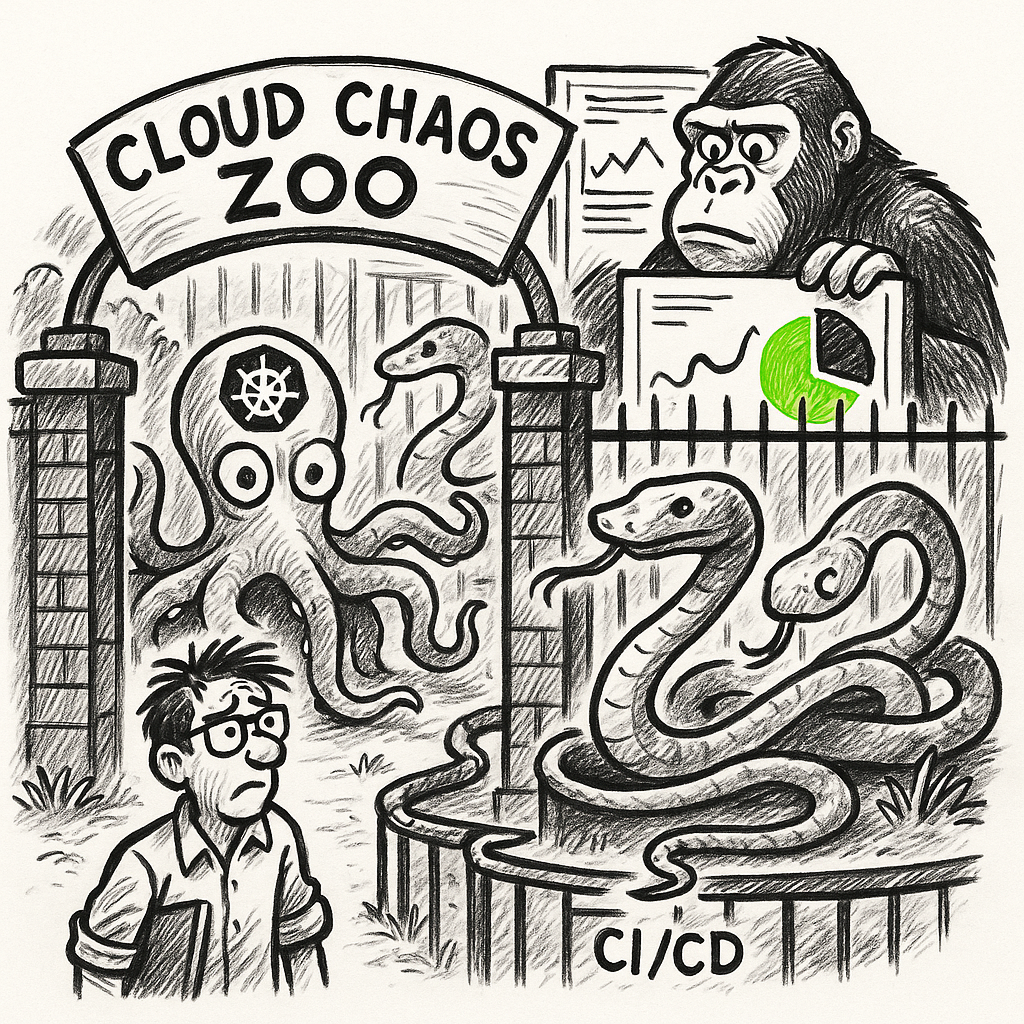
What began as simplification has become a system of silos.
You’re no longer leading transformation. You’re managing operational chaos.
Act II: The Great Abstraction Lie
Abstraction is the sacred cow of modern architecture.
Hide the hardware.
Abstract the platform.
Standardize the stack.
It starts with good intent.
And ends with no one knowing how anything works anymore.
Every layer promises to make life easier — and quietly moves complexity somewhere else.
Now, instead of solving problems, you’re solving the abstraction about the problem.
And let’s be honest — what you now call DevOps is a Russian nesting doll of reinvention:
- DevSecOps
- FinOps
- GitOps
- RevOps
- PlatformOps
This isn’t innovation. It’s organizational duct tape.
You thought you were decentralizing responsibility.
What you actually did was displace ownership.
Developers don’t know the pipeline. Ops doesn’t know the product.
And nobody knows what broke — or who should fix it.
This is the tax of unmanaged abstraction: complexity without clarity, speed without stability, freedom without focus.
Act III: The Real Discipline Is Subtraction
Here’s your pivotal moment.
Growth is no longer your biggest risk.
Complexity is.
Every microservice adds overhead.
Every dashboard adds noise.
Every tool adds a new place to fail.
And worst of all — every one of these additions feels reasonable at the time.
Until the system grinds.
Until velocity drops.
Until “empowered teams” are just pushing tickets through a maze they can’t explain.
Here’s a rule from the highest-performing teams I’ve seen:
Kill with intent.
What’s the last thing your team removed?
What’s the last service you shut down?
What abstraction did you dare to undo?
Because high-performing teams don’t measure velocity in features.
They measure it in friction removed.

Act IV: Time to Rebalance
If this sounds like you — congratulations.
You’ve reached your Pivot Point.
It’s the moment where:
- The cloud is no longer an accelerator — it’s a drag coefficient
- Tooling is no longer enabling delivery — it’s masking dysfunction
- Your team is no longer empowered — it’s exhausted
What you need now isn’t another tool or framework.
You need to rebalance: your architecture, your ownership, your speed vs. safety trade-offs.
At Pivot Point, we don’t deliver templates.
We deliver transformation fluency — the ability to see what’s working, kill what isn’t, and scale only what deserves to survive.
Because the cloud can be your leverage.
But only if you stop building complexity and start designing momentum.
Final Gear Metaphor:
A Formula 1 car doesn’t win because it has more parts.
It wins because every part matters, nothing is excess, and the driver trusts the machine.
Right now, you’re racing with a parts bin bolted together in the dark.
Let’s strip it back, tune it right, and give your team a system they can actually drive.
Before the engine seizes for good.
Because simplicity isn’t the absence of complexity. It’s the presence of intention.
One Comment
Design for Imperfection. – Pivot Point
at 1 year ago[…] “You moved to the cloud to simplify. Now you’re running a zoo.” Go to Article […]