

The Heisenberg Uncertainty Principle of Organizations
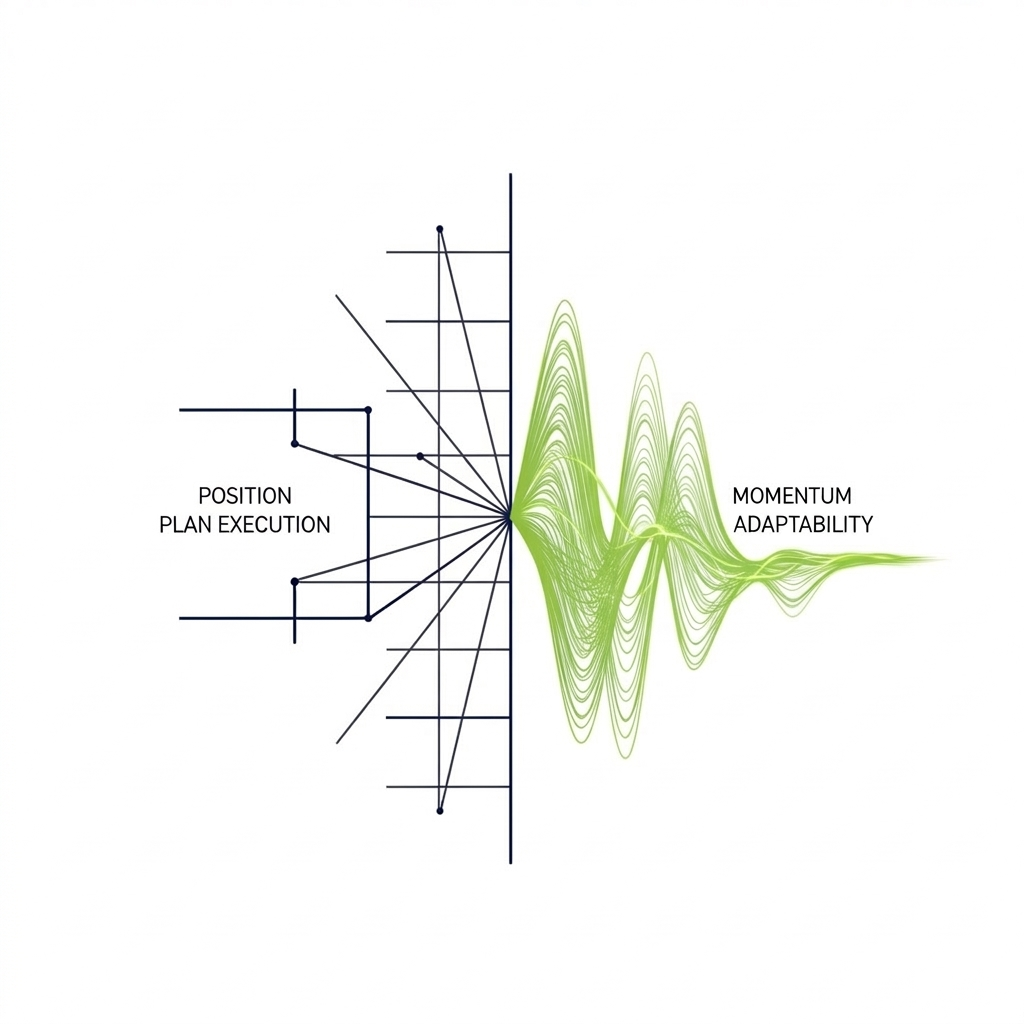
Here is a thought that has stayed with me since I first connected these two worlds.
In 1927, Werner Heisenberg proved something unsettling: you cannot simultaneously know exactly where a particle is and where it is going. The more precisely you measure its position, the more uncertain its momentum becomes — and vice versa. This is not a measurement problem. It is a property of reality itself.
Now replace “position” with “plan execution” and “momentum” with “adaptability.”
The organizational equivalent looks like this: The more energy a company invests in knowing exactly where it stands — whether every KPI is green, every milestone hit, every deviation escalated — the less equipped it becomes to sense where it needs to go. It freezes itself in the present.
And the inverse is equally true: organizations with maximum freedom to pivot and experiment rarely know where they actually stand. The concept of “on plan” barely applies to them.
This is not a management failure. It is structural.
What makes Heisenberg’s insight so powerful as a metaphor is the concept of complementarity. Position and momentum are not two ends of a slider you can optimize toward a golden middle. They are two fundamentally different descriptions of the same system — each valid, each incomplete without the other.
The same applies to control and agility. They are not opponents in a tug of war. They are complementary lenses. And the moment a leadership team tries to maximize both simultaneously — rigorous OKR tracking and continuous pivoting, quarterly plan fidelity and weekly strategy shifts — they are, in effect, trying to violate a law of nature.
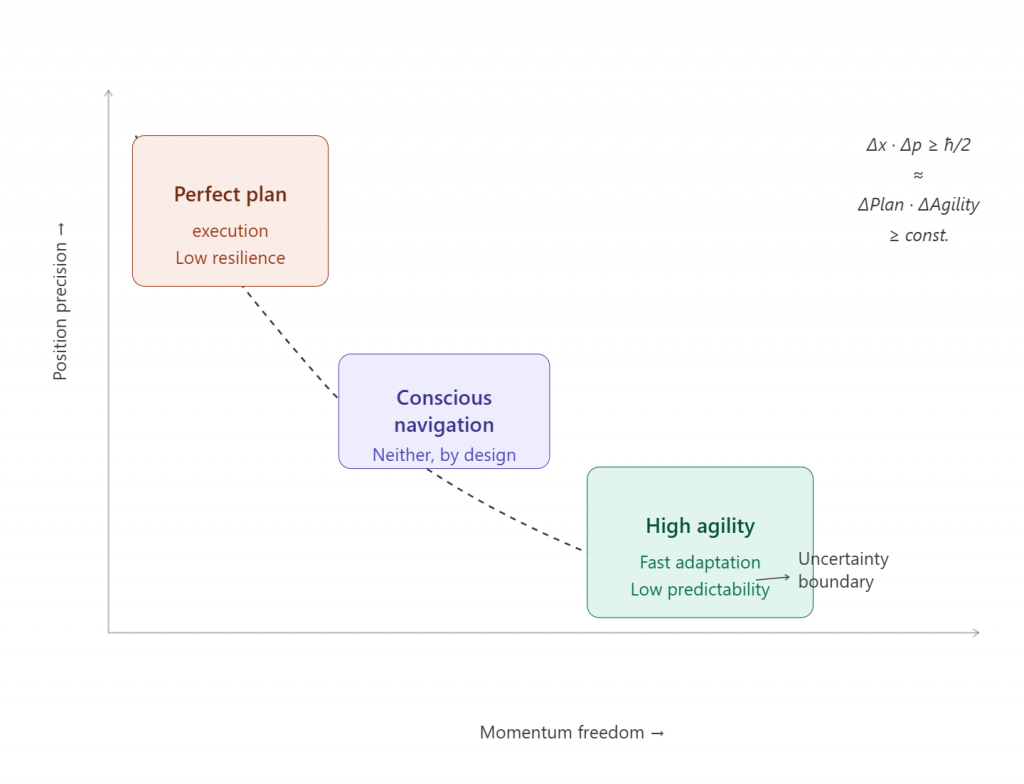
There is one important place where the metaphor breaks down — and it matters.
Planck’s constant ħ is universal and immutable. The organizational equivalent is not. Good architecture — modular systems, short feedback loops, decoupled teams — genuinely reduces the tension. A well-designed organization can hold more of both than a rigid monolith. The boundary is real, but it is not fixed.
What does this mean in practice?
Stop optimizing both levers at once. Instead, ask: What do we need most right now — position or momentum? Strategic initiatives and innovation need momentum measurement (direction, learning, options). Operations and compliance need position measurement (stability, reliability, predictability). These are different “particle types.” They need different measurement regimes.
And perhaps most importantly: trust is the act of consciously relaxing positional precision — not because you have lost control, but because you understand what freedom of movement is worth.
The companies that struggle most are not the ones that chose control over agility, or agility over control. They are the ones that never chose at all, and spent their energy trying to measure both precisely — wondering why the system kept behaving unpredictably.
That is not strategy. That is physics.
What trade-off is your organization currently making — consciously or not?
#productleadership #organizationaldesign #strategy #innovation #leadership