


Imagine two companies—both in the same industry, with similar market access, headcount, and tech stacks. One is thriving. The other is fighting fires, bleeding talent, and losing relevance. The difference? Not strategy. Not funding. It’s how they work.
Let’s walk through their contrasting paths.
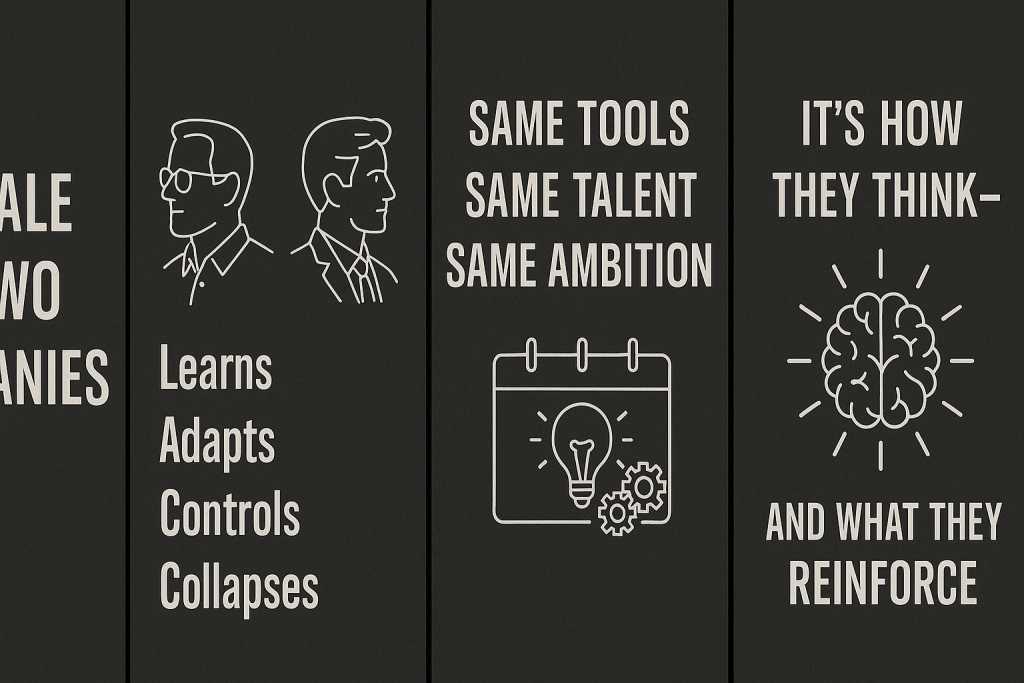
1. Leadership: Coaching vs Controlling
Company A believes leadership means building capability. Managers delegate, coach, and create clarity. Teams make decisions where the knowledge resides.
Company B believes leadership means direction and control. Decision-making is centralized. Fear and blame shape behavior.
The result? Company A moves fast with alignment. Company B moves slowly, despite heroic effort.
2. Product Strategy: Discovery vs Delivery Obsession
Company A constantly talks to users, runs experiments, and adjusts course based on what works. They use dual-track agile to balance discovery and delivery.
Company B ships roadmap items dictated by sales or the CEO. Discovery is seen as a delay.
The result? Company A delivers impact. Company B delivers features that nobody uses.
3. Engineering Maturity: Flow vs Friction
Company A has automated tests, CI/CD pipelines, and deploys with confidence. Engineers own their code in production.
Company B merges long-lived branches every two weeks, relies on manual testing, and prays before releases.
The result? Company A ships daily without drama. Company B lives in release hell.
4. Quality: Built-In vs Outsourced
Company A believes quality is everyone’s job. Testing happens early, telemetry feeds learning, and teams own the outcome.
Company B throws work over the wall to QA and then to support. Quality is a gate, not a practice.
The result? Company A prevents issues. Company B reacts to them—in production.
5. Architecture: Intentional vs Incidental
Company A treats architecture as a product. It evolves through principles and reviews. Teams share a mental model.
Company B lets architecture “emerge” from chaos. Debt accumulates until change becomes impossible.
The result? Company A scales. Company B stagnates.
6. Metrics: Signals vs Stories
Company A tracks leading indicators—cycle time, adoption, retention. They focus on what matters.
Company B counts features shipped and stories closed, mistaking motion for progress.
The result? Company A learns and adapts. Company B celebrates numbers while losing customers.
7. Culture: Learning vs Legacy
Company A hosts blameless postmortems, budgets time for learning, and grows leaders from within.
Company B punishes mistakes, hoards knowledge, and sees learning as a luxury.
The result? Company A improves continuously. Company B runs in place.
What’s the Lesson?
Both companies work hard. Both hire smart people. But only one applies discipline over doctrine, outcomes over outputs, and systems thinking over heroics.
The real transformation isn’t adopting agile or DevOps. It’s choosing which company you want to become—every day, in every decision.