

The convenient lie we tell ourselves
Ask any executive if quality is a priority, and you’ll get the same confident nod. Ask a team lead, and you’ll hear about testing backlogs and tight deadlines. Somewhere in between, quality becomes a noble aspiration rather than an operational reality.
The belief? Quality is the job of QA teams and C-level champions.
The truth? Every leadership layer either defends or dilutes quality. And more often than not, it’s diluted.
Here’s the uncomfortable part: quality doesn’t fail because your QA team missed a test case. It fails because leaders—at every level—make tiny, daily compromises in the name of speed, politics, or convenience. And those cracks? They often appear months later in customer churn, regulatory setbacks, and rework marathons.
Let’s dissect this, layer by layer.
C-level: The storytellers
Vision matters. But when executives preach quality in town halls and tolerate deadline-driven compromises behind closed doors, teams get the message: quality is flexible.
The job of senior leadership isn’t just to endorse quality; it is also to ensure it. It’s to embody it in trade-off decisions. If delivery timelines always win over code health, guess what culture you’re actually shaping?
True quality leadership at this level means:
- Making quality a strategic lever, not a PR line.
- Demanding KPIs that reflect long-term value, not just short-term velocity.
- Saying no to feature-driven pressure that sacrifices system integrity.
You can’t PowerPoint your way to a quality culture.
Middle management: The gatekeepers
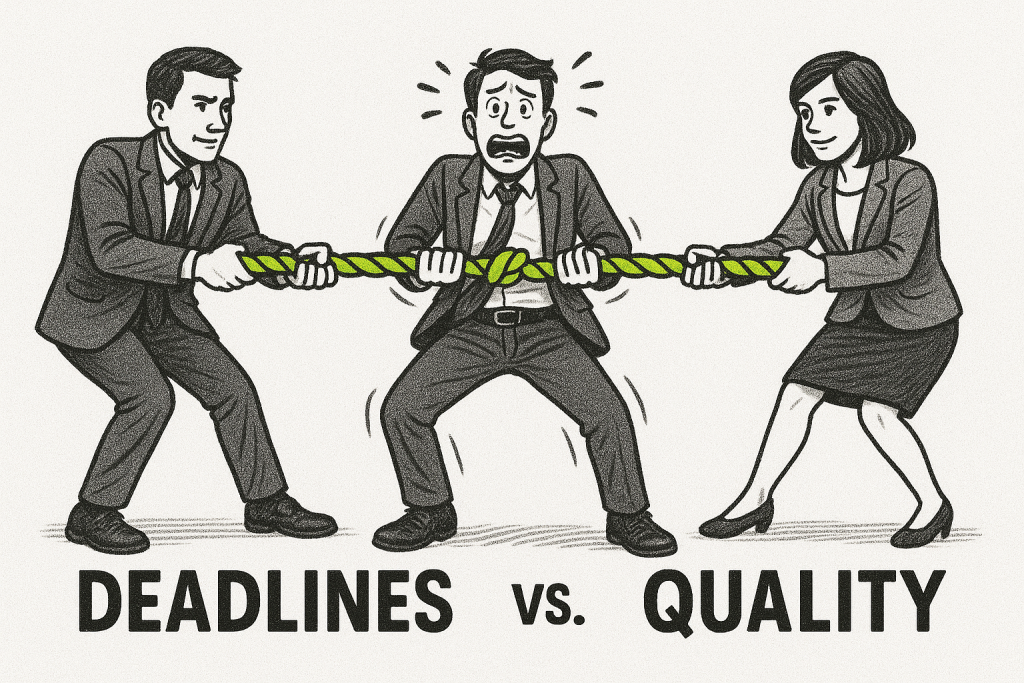
This is where quality most often dies. Not because managers don’t care, but because they’re caught in the impossible triangle: deliver fast, please up, protect down.
So they patch processes. They nod at quality, then wink at shortcuts. They bury risk behind metrics that make slides look good, but systems rot slowly underneath.
What great quality leadership looks like here:
- Creating psychological safety for devs to flag concerns early.
- Escalating issues before they become patterns.
- Prioritizing refactoring and cleanup alongside new features—not after.
If you’re managing the roadmap but ignoring the road condition, don’t be surprised when the wheels come off.
Team leads: The frontline commanders
They’re closest to the code, the customers, and the chaos. And they’re the ones who feel the pressure most intensely. When the build’s broken, the product owner’s hovering, and the sprint review is tomorrow, who has the nerve to say, “No, this isn’t good enough yet”?
That’s the acid test of quality leadership.
Good team leads:
- Make quality visible and discussable in every daily standup.
- Push back when “done” isn’t really done.
- Celebrate bug prevention, not just bug fixing.
Quality isn’t the extra mile. It’s the actual road. And if your team leads don’t feel empowered to stop the truck, you’ll find yourself in a ditch.
The punchline: It’s not about blame
This isn’t a whodunit. It’s a mirror.
Quality fails when every layer assumes someone else is holding the line. But just like football (yes, I went there), if your defense holds but midfield collapses, you’re still conceding goals.
So ask yourself:
- What decisions am I making today that trade away long-term quality for short-term ease?
- Where am I signaling that deadlines matter more than durability?
- Who’s empowered (or scared) to say, “This isn’t ready”?
Because in the end, quality isn’t a role. It’s a responsibility. At every. Single. Level.