


Why AI Leadership Demands More Than Letting Go
Last night’s AI Leadership Meetup didn’t just fill a room—it cracked open a debate that’s been quietly simmering beneath the shiny hype of generative models and synthetic workforces. Jurgen Appelo, calling himself a “skeptical optimist” (a label that fits about as well as a self-driving car fits into a Formula 1 race), laid down some refreshingly raw truths: AI may be the future, but humans aren’t done just yet.
Let’s get one thing straight: AI systems will win in domains where knowledge retrieval and pattern recognition matter more than wisdom or judgment. That’s not just an insight—it’s a warning. It’s like saying your navigation system is better at plotting a route through traffic than you are, but if a bridge suddenly collapses or a protest blocks the road? You’d better know how to take the wheel again—fast.
This is where the analogy with autonomous driving earns its stripes. In many jurisdictions, drivers are still legally required to stay alert during autonomous operation, ready to take control. Not because the AI fails often—but because when it does, it fails hard. And so we train drivers not just to pass a test but to keep practicing. It’s not enough to know how to drive. You need to stay good at it.
Apply this to the workplace, and we’re in dangerous territory. How do senior leaders keep their edge when AI systems outperform them in efficiency? More urgently: how do junior employees gain any edge at all if their early learning years are eaten by hyper-efficient AI proxies?
This isn’t just a philosophical concern. It’s a structural one. Organizations have spent decades building leadership pipelines that rely on apprenticeship—on learning by doing, failing, recovering, repeating. If AI is always doing, and humans are merely observing, where exactly is the leadership of tomorrow supposed to come from?
Now let’s talk vendors. In a world where AI models are commoditized, differentiated only by marginally better prompts or slightly lower latency, how do vendors retain customers? The answer doesn’t lie in just better models—it lies in building trust, transparency, and tools for integration. Offer a “black box,” and you’re inviting your customers to shop elsewhere. Offer a cockpit—and let your customers fly the damn plane—and they’ll stay loyal.
And copyright? IP protection in the AI age is already looking like a cat-and-mouse game between creators and the remix culture of models trained on scraped data. If your strategy depends on owning the data, buckle up. The real game will be in owning the context—how that data is applied, combined, and tuned to solve specific problems.
There’s a wildcard too: cost. What happens when AI hardware becomes cheaper, faster, ubiquitous? That’s not a utopia. It’s a rebalancing act. Think of it like the democratization of car manufacturing. Suddenly everyone can build a car—but not everyone can design a Ferrari. The true winners? Those who can still engineer differentiation at scale.
Appelo’s 90-minute session flew by. Not because it was filled with answers—but because it hit the right questions. And those questions won’t just define the next version of your product. They’ll define your relevance as a leader in the age of intelligent systems.
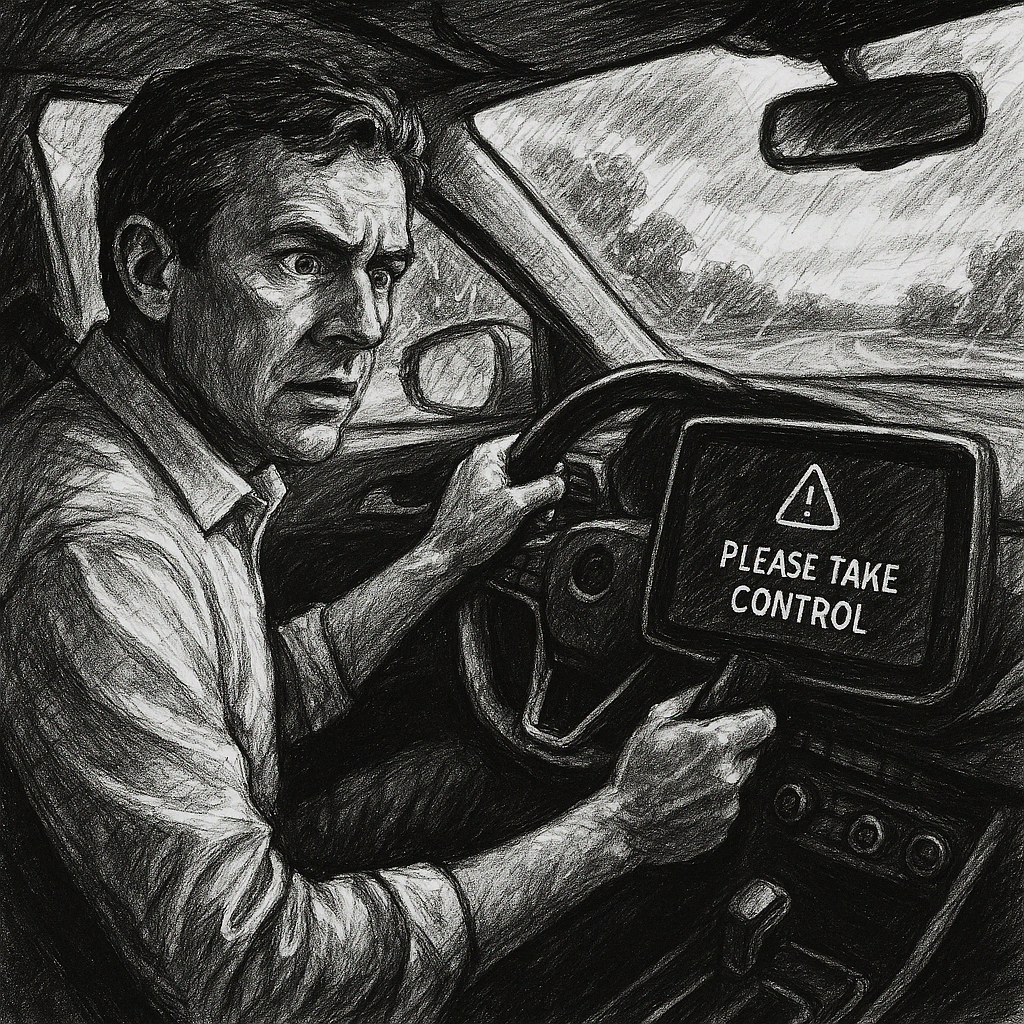
So, here’s the closing question: when the AI driving system says, “Please take control,” will you still remember how to steer? Or will you reach for the manual—and realize it was never written for this kind of road?