

The Myth of Harmony
Let’s get this out of the way: if your product and technology teams always agree, you’re either not trying hard enough or you’re in trouble and don’t know it yet.
Too often, companies chase a mythical state of cross-functional harmony. Politeness masquerades as alignment. But when the goal becomes “getting along” rather than “getting it right,” you lose the very friction that fuels progress. That, my friends, is the quiet death of innovation.
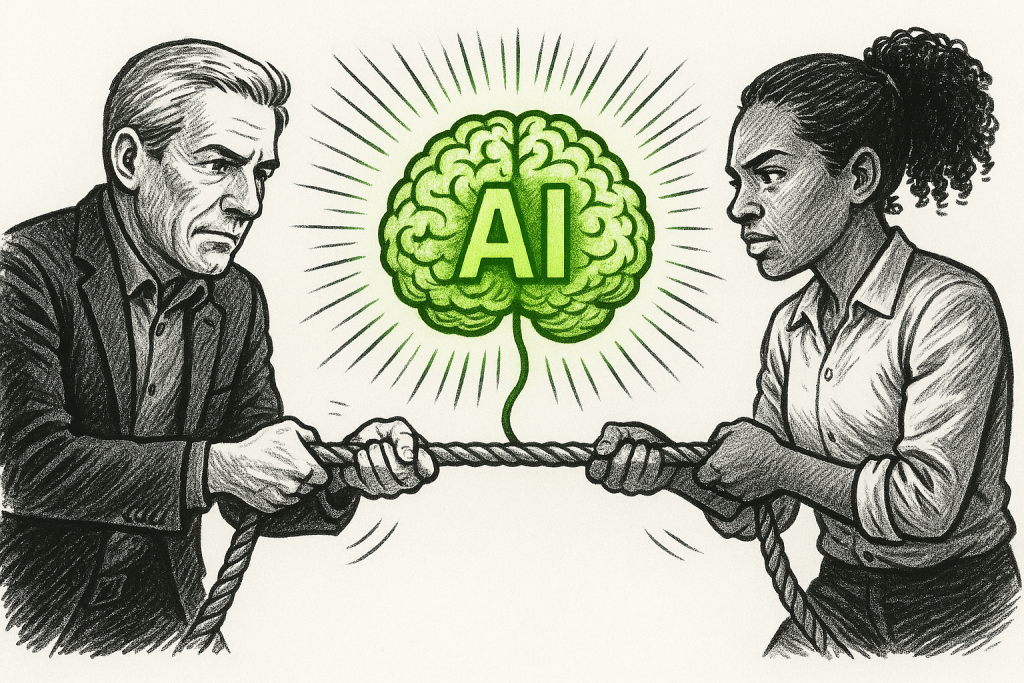
Now throw AI into the mix. Suddenly, everyone’s pretending to be an expert. Technical teams are eager to experiment. Product managers are under pressure to “do something with AI.” Everyone wants to move fast. Few stop to ask if they’re moving smart.
The truth? Innovation isn’t born from consensus. It’s forged in respectful disagreement—where product challenges tech, tech counters with feasibility, and both wrestle their way toward the best possible solution.
Just like in football, where a tough match sharpens a team’s edge, disagreement in tech and product teams is the training ground for world-class execution.
The Power of Constructive Clash
Real progress emerges when teams challenge each other with integrity. That means product leaders must be willing to say: “That’s technically elegant, but it’s not solving a real user problem.” And engineering leaders must be free to reply: “Your vision is compelling, but we can’t scale that without rewriting the core platform.”
This isn’t dysfunction. This is the system working.
When Product and Tech operate in healthy tension, three things happen:
- Blind spots shrink. You stop mistaking elegance for value or market desire for feasibility.
- Quality improves. Because hard trade-offs are debated, not assumed.
- People grow. Teams learn to argue with purpose and listen with humility.
But achieving this balance isn’t easy. It requires:
- Psychological safety to challenge assumptions without fear.
- Leadership maturity to reward outcomes over ego.
- Organizational design that puts collaboration over silos.
Think of it like tuning a high-performance engine. Too much slack, and nothing fires right. Too much compression, and it seizes. The magic is in the tension.
AI: The Double-Edged Catalyst
Enter AI: a technological inflection point that accelerates everything—including dysfunction.
Used wisely, AI tools can deepen insights, enhance speed, and unlock entirely new capabilities. Used poorly, they amplify noise, shortcut thinking, and flood teams with half-baked prototypes no one can explain or scale.
Here’s the uncomfortable truth: the better your Product-Tech relationship, the more valuable your AI investments become. Why? Because:
- AI needs grounding. Product brings the use-case clarity.
- AI needs rigor. Tech brings the architectural discipline.
- AI needs skepticism. Both sides must question hype before committing resources.
A strong, respectful clash helps you avoid what we see far too often: aimless AI sprints, tech-driven experiments detached from value, or worse—an entire roadmap built around a buzzword.
In a recent workshop with a scaling SaaS company, we saw this play out in real time. The tech team demoed an AI-powered feature that dazzled everyone—except the product manager, who calmly asked, “What problem are we solving here?” That single question saved the company six months of misguided development.
What Great Looks Like
In high-performing organizations, this dynamic tension is intentional. It’s visible. It’s coached. And it’s built into the way teams operate.
- Product leaders frame decisions with clarity, challenge assumptions, and invite critique.
- Technology leaders offer constraints as creative inputs, not roadblocks.
- Executive leadership fosters a culture where friction is seen as fuel, not fire.
These teams don’t waste energy on turf wars or ego. They aim their tension at the problem—not each other. They know that “constructive clash” isn’t just a nice-to-have; it’s a strategic advantage.
In a world where AI promises to change everything, the real question isn’t whether you’ll use it. The question is whether your teams are ready to fight—productively, respectfully, relentlessly—for what matters.
Because innovation doesn’t come from being nice. It comes from being better than yesterday.
And that begins with disagreement.
Let the clash begin.