


Your Silent Organization Killer

Imagine for a moment your favorite football team. The season is in full swing, and your star striker is scoring goals game after game. But gradually, unnoticed by most fans, something changes. Training sessions are skipped, fitness routines ignored, injuries patched up with painkillers instead of proper recovery. Initially, performance stays high, but over time the inevitable occurs—the team’s play deteriorates, injuries multiply, and suddenly your winning streak turns into an embarrassing series of defeats. Fans are furious, management demands explanations, but the problem runs deeper than simply blaming players. Welcome to the world of Technical Debt—your organizational equivalent of neglected training and unaddressed injuries.
Technical Debt, or more accurately, organizational debt, is far more insidious than simple bad coding practices. It arises when organizations, driven by short-term expediency, allow developers—sometimes even encourage them—to “take shortcuts,” effectively mortgaging the future agility of the team. Like financial debt, these shortcuts must be repaid with interest, consuming increasing amounts of resources and ultimately grinding your organization’s innovation capabilities to a halt.
A recent study shockingly revealed that software developers spend an average of 23% of their time simply managing technical debt. This isn’t productive work; it’s firefighting—patching broken architectures, performing redundant tests, and rewriting poor documentation. It’s the equivalent of a skilled mechanic forced to spend a quarter of his time reattaching parts of a car that should never have come loose in the first place. Imagine losing one day of every week to fixing mistakes rather than progressing your core business—because that’s precisely the cost technical debt extracts.
Yet, technical debt isn’t fundamentally technical; it’s organizational. The root cause is an all-too-common dysfunction: leaders who don’t fully grasp the consequences of “quick wins.” Technical decisions, after all, are rarely made by engineers alone. They’re influenced by executives and managers, chasing quarterly profits or pressured by shareholders into demonstrating constant visible progress. The result? Short-term velocity traded for long-term sustainability.

Take the automotive industry as another powerful analogy. Would you drive a car if you knew that the manufacturer had skipped critical quality checks to hit the market faster? Probably not. Yet businesses routinely do exactly that with software, operating systems, and platforms—driving headlong towards disaster with flawed products barely held together by proverbial duct tape.
Who benefits from this chaotic approach? Definitely not your customers, whose user experience deteriorates as slow updates and increasing errors frustrate their interactions. Certainly not your development team, whose morale plummets as they’re trapped in cycles of repetitive, soul-sapping maintenance work. Executives might see temporary boosts in performance indicators, but these “wins” are fleeting, swiftly followed by organizational inertia and spiraling repair costs.
A McKinsey survey underscores this grim reality: CIOs report that up to 40% of their entire technological asset value is effectively “technical debt principal.” If your CFO heard 40% of your balance sheet was hidden debt, they’d have a meltdown. Yet this silent drain on resources often goes unnoticed until catastrophic system failures or missed market opportunities reveal the true scale of the problem.
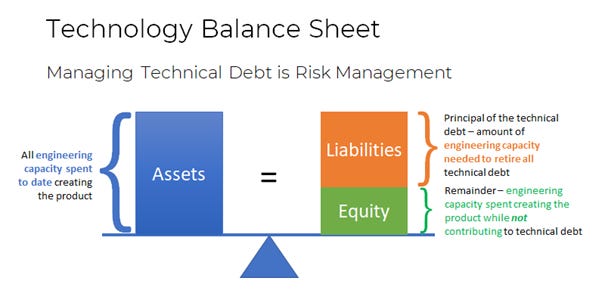
So how do you break free of this debt spiral? Start by seeing technical debt not as a technical nuisance but as a critical business risk. Just as prudent financial management includes strategic debt reduction, organizations must invest systematically in reducing technical debt. Encourage transparency and accountability, so that everyone—especially leadership—understands the long-term consequences of today’s shortcuts.
Addressing technical debt isn’t optional—it’s a strategic imperative for organizations aspiring to sustained digital success. Just as no team ever won a championship ignoring its physical health, no organization achieves digital agility ignoring technical debt.
Let me leave you with a striking automotive metaphor: continuing to accumulate technical debt is like continuously patching a rusting vintage car to compete in Formula 1. It might look charming and run passably at first, but sooner or later, it will break down spectacularly at the first demanding turn.
The question you should ask your organization isn’t whether you can afford to address technical debt—it’s whether you can afford not to.