


If your delivery cycle still runs on seasons, don’t be surprised when your product feels out of date.
Let’s cut to it: organizations that learn fastest, win.
But you can’t learn if you’re moving like molasses. And right now, too many teams are still stuck in quarterly release cycles that feel more like corporate rituals than real progress.
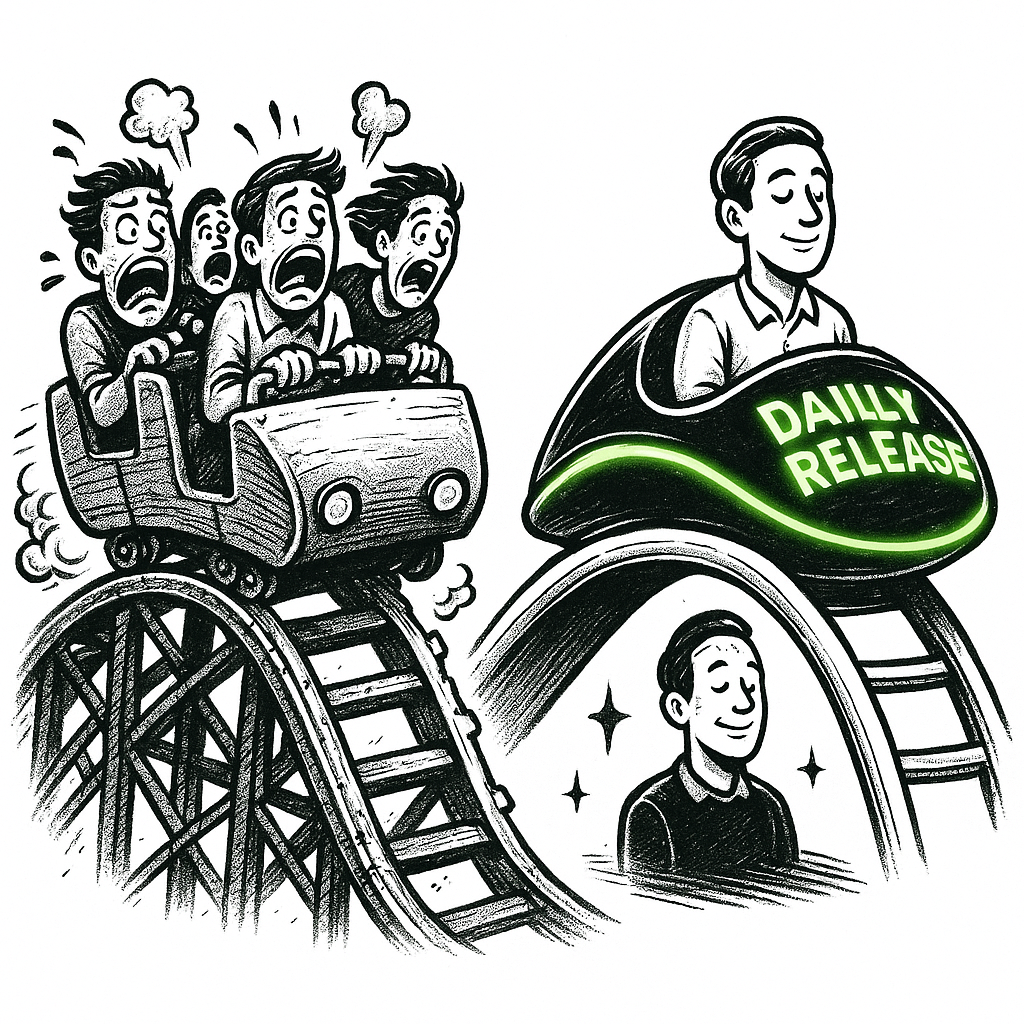
Three releases a year isn’t a strategy. It’s a stalling tactic.
You spend months building the wrong thing. Then even more time defending why you built it. All while the market moves on, competitors ship updates weekly, and your best engineers wonder why they’re debugging code they wrote nine sprints ago.
That’s not just slow — it’s expensive.
Because what you’re really burning isn’t just budget.
You’re burning feedback.
Slow cycles starve you of signal
Let’s call it what it is: long release intervals are a tax on learning.
You delay validation. You postpone insight. You bury bugs under six layers of PowerPoint until they explode in production.
And the longer you wait, the more painful it becomes to change course. You’re not agile. You’re stuck — waiting on the world to tell you what your roadmap should have been.
Meanwhile, every assumption goes unchallenged. Every decision calcifies. Every roadmap turns into a list of expensive bets made in the dark.
You’re not managing complexity.
You’re memorializing it.
Faster releases, faster truths
Now picture this: You deploy weekly. Or daily.
Suddenly, feedback is part of the process — not a postmortem. Teams validate ideas quickly. Engineers see impact fast. Bugs surface before customers rage. Assumptions get tested, not protected.
Momentum becomes muscle.
And here’s the twist: the point isn’t just speed. It’s repeatability.
Frequent releases force your system to reveal its cracks:
- Every flaky test becomes visible.
- Every manual step becomes a bottleneck.
- Every “we always do it this way” gets challenged.
Yes, it hurts at first. But it’s the pain of growth — not collapse.
The very act of accelerating uncovers what you need to fix to scale.
Compliance isn’t your excuse. It’s your opportunity.
Still think faster releases break compliance? Flip it.
- Automated tests become your audit trail.
- CI/CD pipelines enforce policies consistently.
- Security checks happen by default, not as an afterthought.
Shorter cycles don’t weaken governance. They operationalize it.
This isn’t chaos. It’s control — designed for speed.
The maturity curve: From heroics to habits
No one wakes up shipping daily.
Here’s how the progression usually looks:
- Annual: Everything is a Big Bang. Every release feels like a root canal.
- Quarterly: Better rhythm, but feedback still arrives post-mortem.
- Monthly: CI/CD begins. Some wins. Still patchy.
- Weekly: Teams trust the pipeline. Automation stabilizes delivery.
- Daily: Changes flow like water. Guardrails, not gates. Confidence climbs.
Each level demands stronger engineering, tighter architecture, and smarter leadership.
But here’s the good news: you don’t need daily releases to start.
You just need shorter ones than today.
Pivot Point: Release cycles as transformation levers
At Pivot Point, we see release frequency as the heartbeat of product health. Not just for engineering — but for everything that surrounds it.
Want to know how fit your organization really is?
Watch how often it learns from what it ships.
Faster cycles touch all six Pivot Point dimensions:
- Leadership: Trust replaces control. Alignment replaces escalation.
- Innovation: Ideas become hypotheses. Hypotheses become insight.
- Experience: UX is driven by usage, not just design reviews.
- Engineering: Pipelines, automation, delivery discipline.
- Architecture: Modular, decoupled, testable. Not fragile, bloated, or tribal.
- Quality: Built-in. Not bolted on.
Release cadence isn’t a DevOps metric.
It’s an org-wide signal.
Start where you are. Move forward with intent.
Forget the hype around daily deployments. You don’t start there.
You start by shipping one step sooner. One step safer. One step smaller.
How to begin:
- Map your current delivery rhythm.
When do you actually ship? Not when you plan to. - Surface your blockers.
Manual steps, flaky tests, brittle environments — name them. - Pick one. Fix it. Automate it. Move.
Don’t boil the ocean. Create flow. - Make learning visible.
Don’t just celebrate features. Celebrate what they taught you.
Because progress doesn’t come from grand transformations.
It comes from shrinking the gap between input and insight.
Smaller bets. Faster feedback. Sharper decisions.
That’s the compounding magic of speed.
Want to know how close you are to sustainable momentum?
Take our Pulse Check — or join a Pivot Point Anamnesis Workshop to find out what’s really slowing you down.