


Let me tell you a story you’ve heard before. In fact, you’re probably living it.
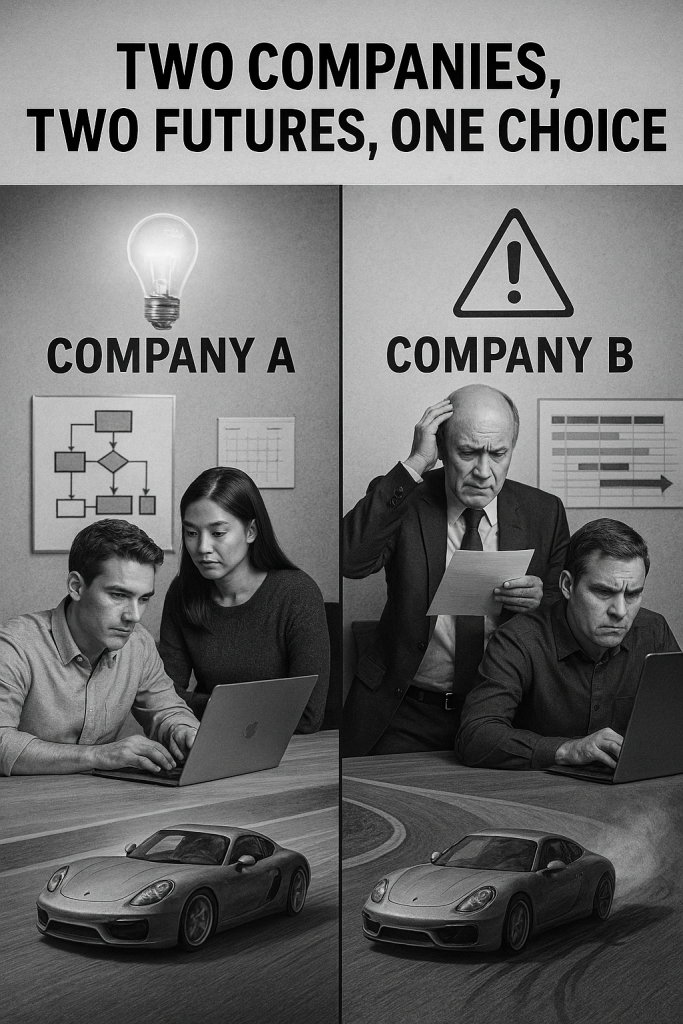
Two companies. Same industry. Same funding. Same access to talent, tools, and technology.
But one breaks through. The other breaks down.
The difference isn’t in their stack, their logo, or their board. It’s in the invisible choices they make every single day—the choices that don’t show up in a strategy doc, but are baked into how they lead, how they build, and how they learn.
The Engine’s the Same. It’s the Driver That Matters.
Think of two identical cars on a racetrack. One hugs the corners, glides through gears, and adapts to track conditions. The other jerks from turn to turn, redlines unnecessarily, and blames the tires for every skid.
You know which car wins. The real question is: which one are you driving?
In digital product organizations, the myth of the unfair advantage is persistent. “They had more capital.” “They hired a rockstar CTO.” “They picked the right tech early.”
But more often than not, it’s not about what you have. It’s about what you do with what you have.
Company A vs. Company B: It’s Not Just a Fable
In Company A, the product team has a hypothesis. They put it in front of users before a single line of code is written. The discovery takes a week. The impact lasts a year.
In Company B, the same idea gets roadmapped, specced, resourced, and shipped—over five months. Nobody uses it. They wonder why.
Company A doesn’t move faster because they have better developers. They move faster because they’ve stopped worshipping motion and started respecting learning.
Here’s what most people get wrong: They confuse structure with progress. They equate activity with value. And they assume that good intentions and smart people will self-organize their way to success.
Spoiler: They won’t. Not without frictionless systems, principled leadership, and the courage to question legacy logic.
The Real Divide: Learning Organizations vs Legacy Thinking
Legacy thinking isn’t about old technology. It’s about mental models stuck in the past.
In legacy-thinking organizations:
- Strategy is top-down. Discovery is reactive. “Agile” is just a new way to write Gantt charts.
- Architecture decisions are made to please procurement, not empower teams.
- Risk is avoided, not managed. Failure is punished, not studied.
Learning organizations, on the other hand, look very different:
- Engineers pair with product from day one. Not to deliver specs, but to discover what matters.
- Teams push to production daily—not because it’s cool, but because it creates feedback loops they trust.
- Retrospectives aren’t rituals. They’re rituals with teeth.
The irony? Company B often has the same goals as Company A—faster delivery, better outcomes, more innovation. But they believe these are the result of pressure, control, and scale.
Company A knows they’re the product of clarity, trust, and small bets.
Why Football Teams Change Coaches—Not Uniforms
Let’s switch the metaphor.
When a football team underperforms, they don’t blame the jersey. They examine the system: playbook, mindset, roles. A coach who understands systems thinking will swap formations before swapping players. They’ll fix the way the team works before questioning the team itself.
In tech companies, we do the opposite. We change tools, hire consultants, run a “transformation,” and then ask why nothing stuck.
Here’s why: most transformations fail not because the tools were wrong—but because the thinking never changed.
You can’t fix cultural dysfunction with a Jira workflow.
Best Practices Are Contextual. But Bad Practices Are Universal.
Yes, every company is different. Yes, best practices are situational. But bad practices? They’re stunningly predictable.
- Leaders who don’t trust their teams create teams that are untrustworthy.
- Organizations that measure output get exactly that—output, not outcomes.
- Teams without autonomy are never accountable. They’re obedient.
The worst part? These companies don’t implode immediately. They slowly lose relevance. The smart people leave first. The ones who stay learn to stop caring. And the leadership keeps asking, “Why is morale so low?”
The Tale Isn’t Just a Metaphor. It’s a Mirror.
If you see both companies in your org, good. You’re paying attention.
Every company has both narratives playing out somewhere in its structure.
The real question is: Which one are you scaling?
The tale isn’t about good vs evil. It’s about clarity vs confusion. Ownership vs excuse. Learning vs inertia.
And you’re not just watching it unfold.
You’re writing it.
🟢 The Pivot Point
The good news? You don’t need a complete re-org to shift the story.
But you do need to stop pretending that practices are neutral.
Every standup, every code review, every retro, every release—it’s either reinforcing Company A or Company B.
You can’t outsource transformation. You can only lead it.
And if you’re not steering with intention, entropy is.
Because in the end, the tale of two companies is really the tale of two choices:
- Build the system that works for you.
- Or become the system that worked… for someone else.