


There’s an uncomfortable truth lingering in the corridors of digital product management and product development: too many executives still believe that top-down mandates and rigid change management processes will reliably steer their companies through turbulent seas of digital transformation. But let’s be blunt—this is about as effective as shouting navigation commands from the shore to a boat already adrift.
Traditional change management is often approached as if it’s just another task to check off, like painting the office walls a new shade of beige. Transformation leadership, however, isn’t a paint job—it’s about tearing down walls and rethinking structures fundamentally. It’s the difference between keeping your old sailing rig and boldly upgrading to a fully autonomous, agile vessel ready for stormy seas.
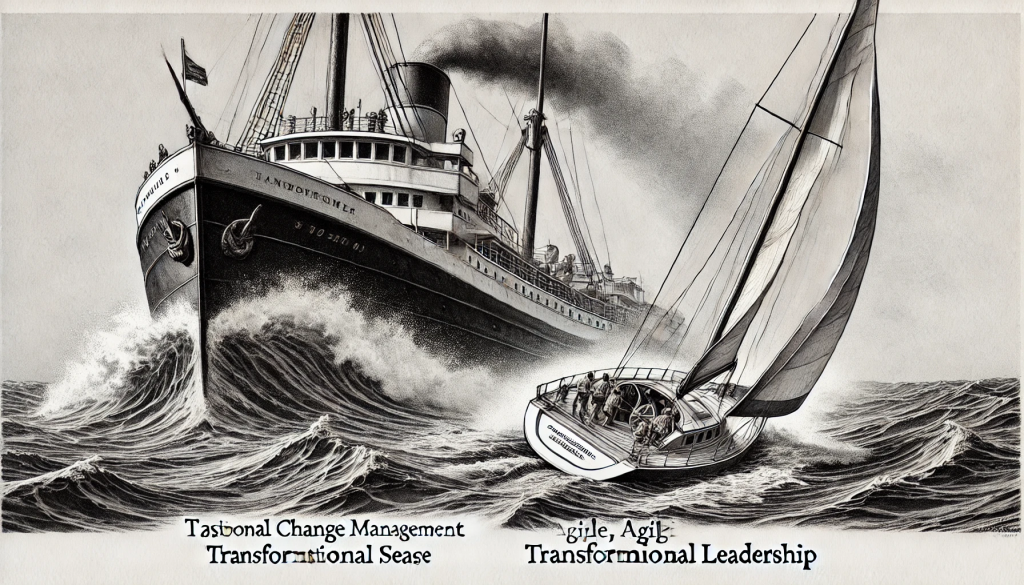
Change vs. Transformation: More than Semantics
Let’s clear the air: Change management is tactical—it’s about following procedures, minimizing resistance, and controlling variables. It’s transactional at its core, relying heavily on linear, predictable, and often inflexible roadmaps. Transformation leadership, conversely, is inherently inclusive and strategic. It’s visionary, engaging teams at all levels, and it emphasizes learning and adaptability rather than obedience.
To put it simply, change management is akin to patching leaks on your boat as they appear, whereas transformation leadership is redesigning the vessel to prevent leaks altogether. It’s about empowering the crew with the skills, autonomy, and authority to navigate, innovate, and adapt.
Why Traditional Approaches Fail—and Transformation Leadership Succeeds
I’ve observed this repeatedly: companies apply rigorous, top-down change management methods, only to see their teams disengage and their products stagnate. In contrast, when I led agile transformations at several organizations, the most powerful changes happened when we prioritized psychological safety, transparency, and iterative learning over rigid control.
Consider the classic misstep of executives who pile long lists of unclear requirements onto their teams. This is the equivalent of overloading your boat with cargo while leaving your crew uncertain of the destination or even how to operate the sails. The result? Lost direction, wasted resources, and demoralized teams struggling against avoidable headwinds.
Who Actually Benefits from Your Approach?
Here’s the critical question executives rarely ask themselves: who truly benefits from your top-down, directive approach? The unsettling truth? Primarily executives and managers, who often confuse busywork and extensive documentation with genuine progress. The users, engineers, and ultimately the entire organization become secondary. A transformation leader flips this equation, placing user experience, engineering excellence, and innovation at the forefront—aligning perfectly with frameworks like Pivot Point, which emphasizes balancing strategic oversight, innovation, user experience, and quality.
During my tenure at another business, we took exactly this transformative route: abandoning outdated practices and giving our teams the autonomy to experiment, leading to breakthroughs like an AI-enhanced SaaS-based platform. Such outcomes simply aren’t possible in organizations chained to top-down change management mandates.
Don’t Just Manage—Transform Your Way Forward
Navigating through digital transformation is less like steering a barge and more akin to sailing a racing yacht. A barge moves slow, predictable, controlled from the bridge—much like traditional change management. But a yacht, under transformational leadership, is quick, responsive, and adaptive, powered by a skilled, empowered crew making decisions in real-time based on conditions at sea.
So here’s the reality check: If your digital or any other significant organizational transformation feels more like slowly steering a barge than racing ahead on a responsive yacht, it might be time to toss the old management playbook overboard. Embrace transformational leadership—where your crew doesn’t just follow orders, but charts the course with you, navigating confidently toward innovation, agility, and lasting success.